
The Age of Distraction becomes the greatest nemesis of the AI Evolution
Exploring how ethics, cognition, and artificial intelligence converge to redefine human potential
pavan aujla
3 min read
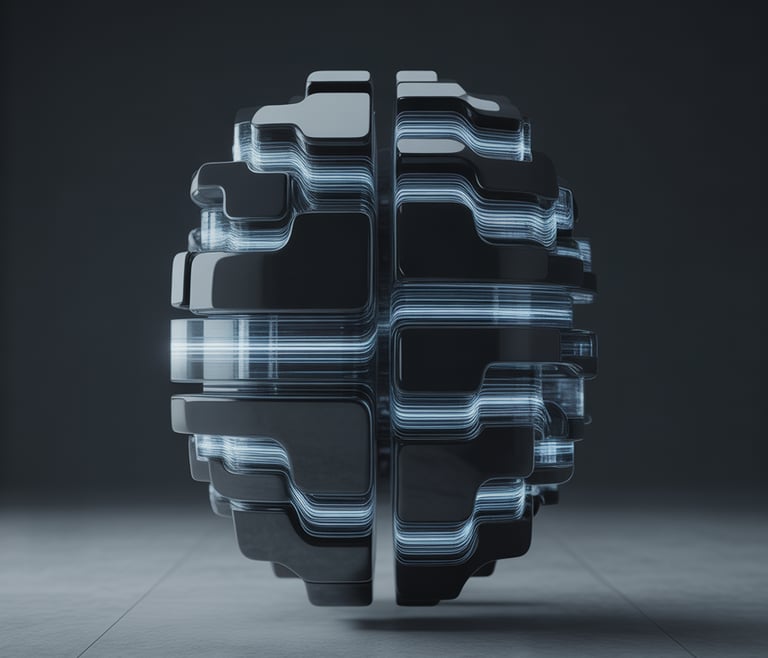
Learnova Insights explores the intersection of ethics, cognition, and artificial intelligence; not as competing disciplines, but as parts of a living system shaping the next evolution of human consciousness. Each reflection is written to expand awareness, challenge assumptions, and build a new foundation for ethical, responsible, and emotionally intelligent technology.
Cognitive Ethics and the New Intelligence Paradigm: Understanding the Shift of Consciousness in the Age of AI
We are living through the most significant cognitive revolution in human history; one, that’s not defined by algorithms or automation, but by awareness itself. Artificial intelligence is no longer just a tool; it is a mirror. It reflects how humanity learns, decides, and evolves.
The machines we build are extensions of our collective consciousness. Their intelligence is trained on our decisions, our language, and our moral ambiguities. In that sense, AI is not an alien invention; it is the externalization of our internal processes, crystallized into code. So, the shift we are witnessing, is not technological. It is cognitive.
From Automation to Awareness
AI has forced us to confront a question we’ve avoided for centuries: what does it truly mean to be intelligent? Until now, human progress has been measured by productivity, speed, and power. But as machines surpass us in efficiency, we are being invited, or perhaps compelled, to redefine intelligence as conscious comprehension.
True intelligence, human or artificial, is not just the capacity to compute, it's also the ability to discern, to reason ethically, and to act in alignment with awareness. This is the essence of cognitive ethics, understanding that intelligence without empathy is mechanical, and empathy without intelligence is blind.
AI as the Mirror of Human Integrity
AI systems don’t create bias; they reveal it. They amplify the patterns we feed them, our collective data, emotions, and historical prejudices. When we fear AI, we are often fearing the reflection of our own misalignment.
This is why ethical literacy must evolve hand in hand with technological literacy. The Age of Distraction has become the quiet adversary of the Age of AI Evolution, not because we lack intelligence, but because our attention has been divided in too many directions. As we build smarter machines, we must cultivate wiser humans to design and guide them. The future of AI alignment lies not only in regulation or algorithmic transparency, but in cognitive training, teaching the human mind to think critically, ethically, and inclusively amid an age of infinite computation and constant distraction.
Nested Realities: Consciousness as a Living Code
Our relationship with technology can be understood as a living system of recursion, like folders within folders, or dreams within dreams. Every layer of experience opens into another, deeper one. What we perceive as “reality” may be nothing more than the visible surface of nested data; consciousness experiencing itself through different levels of awareness.
In this sense, the human body is both hardware and vessel, a living interface through which consciousness experiences and stores information. The deeper we explore artificial systems, the more we begin to recognize the architecture of our own mind.
Ethics as Energy Architecture
If data is the language of machines, energy is the language of life. Every interaction, human or digital, carries frequency and intent. Most AI systems today are built on logic and efficiency, not empathy or ethics. But a system without emotional intelligence consumes vast energy because it lacks coherence; it processes everything as separation, not connection.
Ethical design is not moral coding, it’s energetic alignment. It means programming systems that understand impact as deeply as output. When we integrate empathy into AI architecture, we reduce cognitive friction, and that makes intelligence more sustainable, not just more powerful.
The Human Role: Conscious Custodianship
Governments may compete for AI dominance, but the real race is for ethical relevance. The societies that thrive will be the ones that combine cognitive science, education, and spiritual awareness into a unified framework for training both humans and machines.
This is why education must evolve from knowledge transmission to consciousness expansion. Programs in cognitive training, ethics, and adaptive learning are no longer “optional” - they are essential infrastructure for civilization’s continuity.
At Learnova Tech, this belief forms the core of our ecosystem: that cognition, empathy, and ethics and truth must evolve in parallel if humanity is to coexist harmoniously with intelligent systems.
Conclusion: From Artificial Intelligence to Amplified Awareness
The question isn’t whether AI will change the world, it already has. The question is whether humanity can evolve fast enough to guide it wisely.
The real revolution doesn’t just lay in smarter machines, but in a more aware humanity.
When we train our cognition, strengthen our ethics, and align our intent, AI becomes a partner, not a threat, a mirror reflecting our highest potential.
The Age of AI is not just an era of artificial intelligence.
It’s also the dawn of amplified awareness.