
Why the World Needs a Council Above Nations
Across borders, across ideologies, one truth is emerging: AI is evolving faster than our policies, ethics, and even our imaginations.
pavan aujla
2 min read

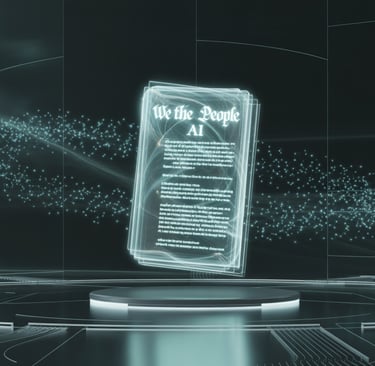
AI Governance
We’re not just approaching a new era of innovation, we’re unlocking a profound opportunity to redefine human agency with intention and care.
Across borders, across ideologies, one truth is emerging: AI is evolving faster than our policies, ethics, and even our imaginations. We’re not just approaching a new era of innovation, we’re unlocking a profound opportunity to redefine human agency with intention and care.
As artificial intelligence continues its rapid ascent, it raises urgent questions: Who gets to decide how AI is deployed? Who governs the machines that could soon govern us? And what happens when the goals of profit, power, and safety collide?
The Limitations of National Governance
Today, AI policy is managed nation by nation, often siloed within economic or defense agendas. Ministries of Innovation, Digital Affairs, or newly formed AI departments attempt to regulate development. But these are fragmented efforts, and they are inherently limited.
While governments focus on national interests, AI is borderless. An LLM trained in Silicon Valley can be deployed in Nairobi. A deepfake algorithm tested in one lab can influence elections across oceans. An autonomous system programmed in one language can impact cultures it wasn’t trained to understand.
In a world where AI moves faster than borders, we have the rare chance to build something even greater: global wisdom and shared responsibility.
Why the World Needs a Shared Ethical Backbone
Historically, when the stakes have been high enough, humanity has found ways to unite:
The Geneva Conventions defined rules of war.
The Antarctic Treaty preserved an entire continent for peace and science.
The Paris Agreement created a global framework for climate cooperation.
None of these systems are perfect, but they are symbols of a shared commitment to something greater than borders.
The same must now apply to AI.
When technology evolves faster than ethics, history shows us who suffers first, the underserved, the unprotected, the unheard. We can’t afford to repeat that cycle.
Imagine This...
Imagine a global observatory of trusted thinkers, philosophers, ethicists, safety engineers, and Indigenous knowledge holders, tasked with sounding the alarm when certain technologies risk human dignity or survival.
Learnova’s Role in This Global Dialogue
At Learnova Tech Inc. , we believe that governance doesn’t start with laws, it starts with literacy.
Our AI mastery pathways are designed to teach not only the “how” of AI, but the “why not.”
We help understand both capabilities and consequences.
We promote ethical foresight as a core skill, alongside prompt engineering or data analysis.
We empower learners from underserved regions to shape the AI future, not just survive it.
This isn’t about who builds the best technology. It’s about who builds it responsibly.
By shaping the moral guardrails of AI now, we give future generations the gift of balance, between progress and protection, between intelligence and integrity.
Let’s ask the deeper question: Not just “what will AI do?” But “who decides what it should do?”
Only humans, grounded in wisdom, can guide what must always remain human.
Published by Pavan Aujla to support ethical innovation, global foresight, and cognitive empowerment.
Citations:
Stanford HAI 2024 Policy Brief: https://hai.stanford.edu/news/policy-frameworks-ethics-ai
UNESCO AI Ethics Recommendation 2021: https://en.unesco.org/artificial-intelligence/ethics
Paris Agreement (Climate Model of Global Cooperation): https://unfccc.int/process-and-meetings/the-paris-agreement
Geneva Conventions on Humanitarian Law: https://www.icrc.org/en/war-and-law/treaties-customary-law/geneva-conventions
UN Secretary-General’s AI Advisory Body Report (2023): https://www.un.org/en/ai-advisory-bod